.webp)
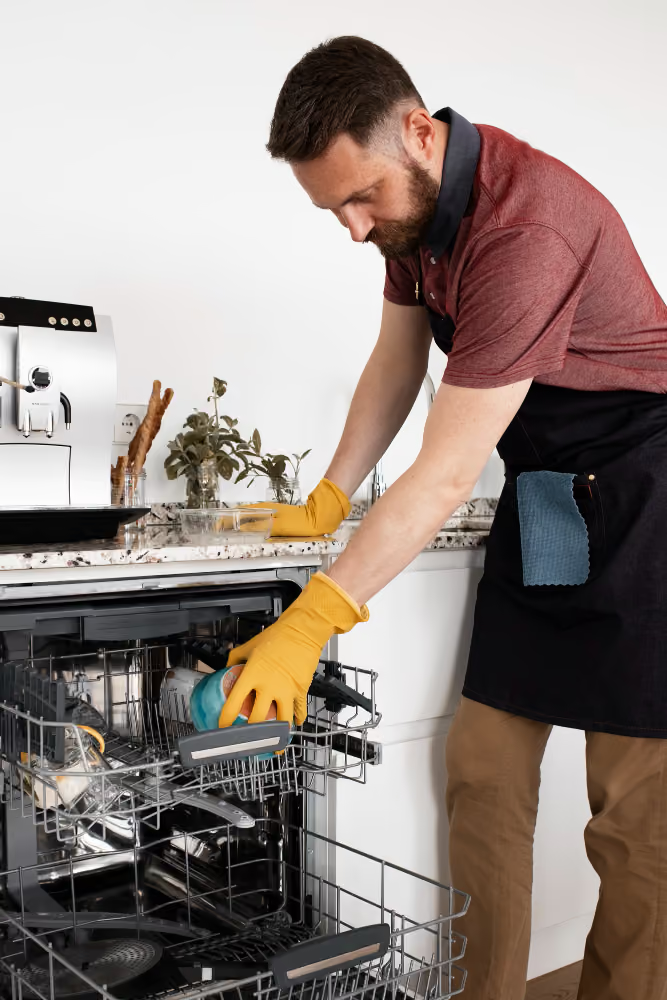
Why is my dishwasher not cleaning dishes properly?
Your dishwasher runs a full cycle, you open the door expecting clean dishes — and everything is still greasy, spotty, or has food stuck to it. This is one of the most common appliance complaints we hear from homeowners in Riverside, Eastvale, Corona, and the surrounding areas.
The good news: a dishwasher not cleaning properly is almost always fixable, and in most cases you don't need to replace the machine. Here are the 6 real causes we find during service calls — and what was wrong with a unit we recently repaired in Riverside.
Cause #1: Clogged or blocked spray arms
The spray arms are the rotating parts that shoot water onto your dishes. Each arm has small holes that can get blocked by food particles, mineral deposits, or broken glass.
When the holes are clogged, water pressure drops and dishes on certain racks don't get properly rinsed — you'll notice the top rack dishes are dirtier than the bottom, or vice versa.
What to check: Remove the spray arms (they usually unscrew or pull off) and hold them up to the light. If any holes look blocked, rinse them under running water and use a toothpick to clear the openings.
In our Riverside service call, a clogged lower spray arm was the main culprit — food debris had built up inside the arm over several months and reduced water flow by about 60%.
Cause #2: Dirty or clogged filter
Most modern dishwashers have a filter at the bottom of the tub that catches food particles so they don't recirculate onto your dishes. When that filter gets clogged, dirty water washes back over everything — leaving a greasy film and food residue.
How often should you clean your dishwasher filter? Once a month is a good rule of thumb for most households. If you run the dishwasher daily or don't pre-rinse dishes, every 2 weeks.
What to check: Look at the bottom of your dishwasher tub. Most filters twist out counterclockwise. Rinse under warm water and scrub gently with a soft brush.
Cause #3: Low water temperature
Dishwashers need hot water — ideally between 120°F and 140°F — to dissolve detergent properly and cut through grease. If your water heater is set too low or the dishwasher's heating element has failed, water won't get hot enough and detergent won't activate.
Signs of a water temperature problem:
- Detergent pod still partially intact after the cycle
- Greasy film on glasses and plates
- Dishes feel cool when you open the door mid-cycle
Quick test: Run your kitchen faucet until the water is hot before starting the dishwasher. This ensures the first fill is already at the right temperature instead of starting cold.
Cause #4: Wrong detergent or too little detergent
This is the cause that surprises most people. Using the wrong detergent — or the right detergent in the wrong amount — can leave dishes just as dirty as a mechanical fault.
Common detergent mistakes:
- Using dish soap instead of dishwasher detergent (causes foam buildup that blocks spray arms)
- Using too little detergent for a heavily soiled load
- Old or clumped detergent that doesn't dissolve properly
- Using powder detergent in a humid environment where it has absorbed moisture
We recommend pods or tablets for most households — they're pre-measured and dissolve reliably. If you use powder, store it in an airtight container.
Cause #5: Overloading or incorrect loading
A dishwasher that's overloaded or loaded incorrectly won't clean properly no matter how good its mechanical condition is. Dishes need space for water to reach every surface.
Most common loading mistakes:
- Nesting spoons and forks together in the cutlery basket — they block each other
- Placing large items like cutting boards or baking sheets on the bottom rack, blocking the spray arm
- Stacking bowls face-up instead of angled downward
- Placing tall items in front of the detergent dispenser
A good rule: every dish should have water visible to it from the spray arm below. If you can't see a clear path, rearrange.
Cause #6: Failing wash pump or motor
If none of the above apply and your dishwasher still isn't cleaning properly, the issue may be mechanical — specifically a weak or failing wash pump. The pump is what forces water through the spray arms at the right pressure. When it starts to fail, water pressure drops and cleaning performance goes down significantly.
Signs of a pump problem:
- You can hear the dishwasher running but water doesn't seem to be spraying
- Dishes in the back corners of racks are always dirty
- The problem has gradually gotten worse over several months
This is the repair that requires a technician. A wash pump replacement typically costs between $150–$300 depending on the brand, which is almost always worth it for a dishwasher that's less than 8–10 years old.
Related dishwasher issues we see in Southern California
Dirty dishes are just one of the dishwasher problems we fix regularly. We also handle dishwashers not draining, dishwashers leaking from the bottom, and even specific error codes like the Bosch E24 drain error. If your dishwasher has more than one issue, our technician will catch everything in a single visit.
Real case: dishwasher not cleaning dishes in Riverside
A homeowner in Riverside called us after noticing that her dishwasher — a mid-range Bosch — had been leaving dishes dirty for about three weeks. Glasses had a white cloudy film, and food was still stuck to pots after a full cycle.
Our technician Dennis found two issues during the same visit:
- The lower spray arm was 70% blocked with food debris and hard water mineral deposits
- The filter hadn't been cleaned in over a year and had a significant buildup
After cleaning both the spray arm and filter, and running a test cycle with a dishwasher cleaner tablet, the machine cleaned perfectly. No parts were needed — total repair time was about 45 minutes.
The customer mentioned she had almost bought a new dishwasher. She didn't need to.
When should you call a technician?
Try the DIY checks first — filter cleaning, spray arm inspection, loading habits, detergent check. If dishes are still coming out dirty after addressing those, it's time to call. A technician can diagnose a failing pump, heating element, or control board in a single visit.
We provide professional dishwasher repair across Riverside, Eastvale, Corona, Chino, Chino Hills, and Ontario. If your dishwasher isn't cleaning the way it should, we'll find the cause and fix it — usually in one visit.